Why Unique Content Is the Key to Higher Google Rankings
Why Unique Content Is the Key to Higher Google Rankings
You’ve done it all. You’ve read the guides, you’ve followed the checklists. You’ve picked your keywords, optimized your titles and meta descriptions, and made sure your website loads at lightning speed. You’ve ticked all the technical SEO boxes. And yet, you’re still stuck on page two of the Google search results, watching your competitors enjoy all the traffic. It’s one of the most frustrating experiences for any blogger, business owner, or content creator. So what’s the missing piece of the puzzle?
More often than not, the answer isn’t hidden in some complex code or a secret SEO trick. It’s right there in plain sight, in the very words on your page. The missing piece, the engine that drives the entire vehicle of SEO, is unique content.
In the crowded digital world of today, simply having content isn't enough. Your content needs to be different, better, and more valuable than what’s already out there. Let’s pull back the curtain and explore exactly why originality isn't just a nice-to-have, but the absolute, non-negotiable key to dominating the search rankings.
Cracking the Code: What Does Google Actually Want?
To win at the game of SEO, you have to understand the game master: Google. And Google’s mission, its one and only obsession, is to provide the single best, most satisfying answer to a user's question. Think about that for a second. Not an answer. The best answer. A piece of content that simply rehashes what ten other articles have already said can, by definition, never be the "best." It’s, at best, an average answer.
Imagine a teacher asks a complex question in class. One student stands up and recites the definition from the textbook, word for word. A second student stands up and explains the concept in their own words, uses a real-world example to make it clear, and connects it to another idea they learned last week. Who gave the better answer? It’s the second student, of course. Google’s algorithm is designed to be that teacher it’s constantly looking for the answer that shows deeper understanding, offers a fresh perspective, and provides the most comprehensive value.
Uniqueness as a Magnet for Backlinks
One of the most powerful ranking factors in Google’s algorithm is backlinks. A backlink is when another website links to your page, and it acts as a vote of confidence, a signal to Google that your content is credible and valuable. So, how do you get these powerful votes? Well, think about what kind of content you share. Do you share bland, generic articles that state the obvious? Or do you share articles that surprised you, that taught you something new, that presented original data, or that told a compelling story?
The truth is, nobody links to boring content. High-quality, unique content, on the other hand, is a natural link magnet. A journalist might cite your original research. A fellow blogger might link to your insightful case study. An industry expert might share your controversial opinion piece. Originality is what makes your content worth talking about, and those conversations create the backlinks that Google loves to see.
Earning Links, Not Just Building Them
In the old days of SEO, people would try to build links through spammy tactics. That era is over. Today, it’s all about earning links. You earn them by creating something so good, so unique, that other people can’t help but reference it. This is often called "linkable asset" creation. Are you a real estate agent? Instead of another generic "5 tips for buying a home" post, you could analyze local housing data and publish a unique report on the "Top 5 Most Undervalued Neighborhoods in Colombo." That kind of original data is a linkable asset. It provides a unique value that can’t be found anywhere else, making it a natural target for links.
The Secret Language of User Engagement
Google doesn’t just look at what other websites say about you; it pays very close attention to what your actual users do. When a user clicks on your link in the search results, Google starts a stopwatch. It’s watching to see how they engage with your page. One of the most important signals is "dwell time," which is simply how long they stay on your page before going back to the search results.
What keeps people on a page? Interesting, engaging, and unique content. If your article offers a fresh perspective or tells a captivating story, visitors will stick around to read it. This long dwell time sends a powerful positive signal to Google: "Hey, this user found exactly what they were looking for. This is a great result."
Defeating the "Pogo-Stick" Effect
On the flip side, what happens when a user clicks on your link and finds the same generic advice they’ve already read on three other sites? They hit the back button within seconds. This behavior is called "pogo-sticking" bouncing right back to the search results page. This sends a strong negative signal to Google: "This result was not helpful. The user is still looking for a better answer."
If this happens enough times, Google’s algorithm will conclude that your page isn’t a satisfying result, and your ranking will drop. Unique content is your best defense against pogo-sticking. It gives the user a reason to stay, to engage, and to signal to Google that your page is the destination, not just a quick stop on their search journey.
Building Your Kingdom of Topical Authority
As we’ve said before, Google wants to rank experts. It wants to build its search results around websites that have proven their authority on a given topic. You can’t build authority by being a parrot. You build it by being a thought leader. Think of your website as a castle you are trying to build.
Every generic, rehashed article you publish is like a flimsy wooden fence post. It might mark your territory, but it offers no real defense or strength. Every piece of original, in-depth, and valuable content you publish, however, is a solid stone block. When you consistently produce these stone blocks, you build a formidable fortress of topical authority that is incredibly difficult for your competitors to overcome.
So, What Does "Unique" Really Mean in Practice?
Okay, so the theory is clear. But what does "unique content" actually look like? It's more than just avoiding plagiarism. It's about consciously creating value that doesn't exist elsewhere. This can take a few different forms.
First, there's unique data or research. This could be as simple as surveying your social media audience and publishing the results, or as complex as analyzing public data to uncover new trends. Second, there are unique experiences and case studies. Sharing a detailed story about a client's success or a personal journey is content that is impossible to replicate. And third, there are unique perspectives. This is where you connect ideas in a new way or offer a contrarian opinion to the conventional wisdom in your field.
Your Unbeatable Advantage: Personal Experience
Of all the types of unique content, the one that is truly unbeatable is your own story. Your competitors can target the same keywords. They can try to copy your website design. They might even try to replicate your backlink strategy. But the one thing they can never, ever steal is your personal experience, your unique voice, and your brand's personality.
Weaving your own stories, struggles, and successes into your content doesn't just make it unique; it makes it human. It builds a connection with your audience that goes far beyond a simple exchange of information. That connection builds a loyal following, which in turn sends a cascade of positive signals to Google.
The Ultimate Competitive Moat in SEO
When you commit to creating truly original content, you are building a competitive moat around your business. You are creating a brand that stands for something, a resource that people trust, and an asset that becomes more valuable over time. While your competitors are busy churning out generic blog posts that are indistinguishable from one another, you are building a library of unique, authoritative content that will continue to attract links, engage users, and climb the rankings for years to come. It’s a long-term strategy, but it’s the only one that truly works.
Protecting Your Most Valuable SEO Asset
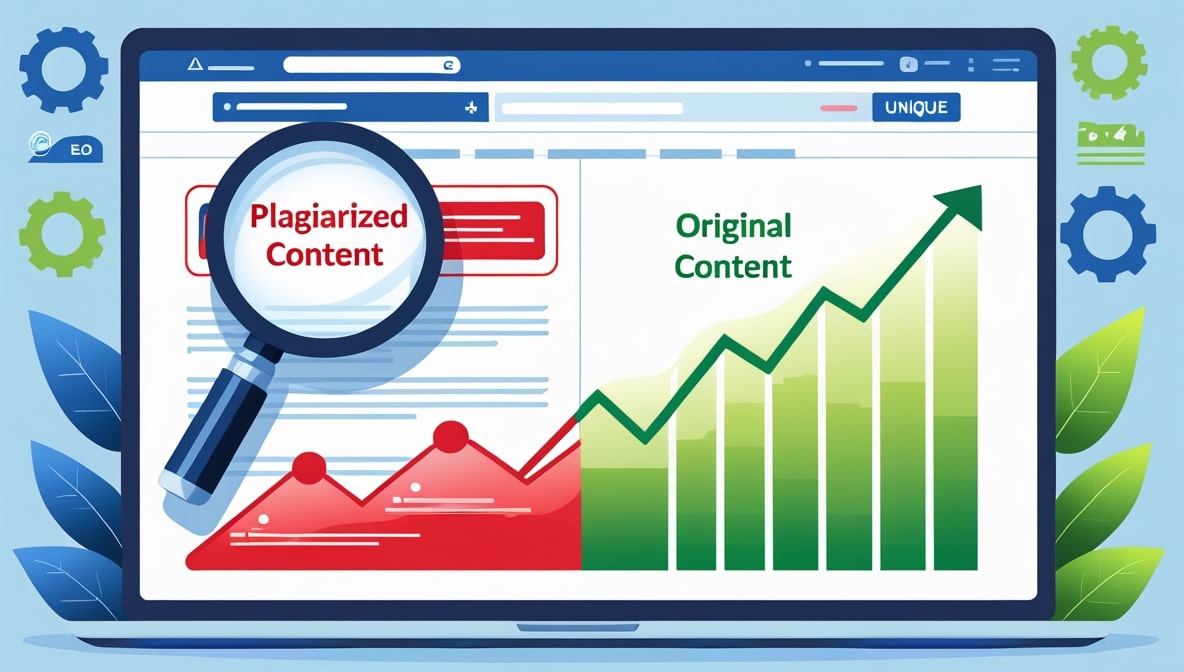
After you’ve invested all that time, creativity, and effort into crafting a masterpiece of unique content, there is one final, critical step you must take before you hit "publish." You need to protect your asset. You have to be absolutely certain that your work is 100% free from any accidental similarities or forgotten citations that could dilute its value in the eyes of Google.
A piece of content that is 99% original but has 1% accidental plagiarism is a damaged asset. It’s like having a beautiful new car with a deep scratch down the side. You need to ensure it's flawless before you show it to the world.
The Final Quality Check for a Perfect Launch
This is where a professional-grade plagiarism checker becomes an essential part of your content creation workflow. Before you publish, a quick scan with a reliable tool like the one we provide at plagiarism-checker.free is your final quality assurance step. It verifies that your article is as unique as you intended it to be. It gives you the concrete proof that you are providing Google with a purely original, high-value piece of content, ready to be indexed and rewarded. It’s the step that turns confidence into certainty.
Stop Chasing Algorithms, Start Creating Value
At the end of the day, the secret to higher Google rankings in 2025 and beyond is to stop chasing the algorithm and start obsessing over your audience. The most effective technical SEO in the world can't save boring, generic content. But content that is genuinely unique, deeply valuable, and authentically helpful will always win. It will win the trust of your users, and as a result, it will win the favor of Google.