Why Every Business Needs a Plagiarism Checker for Website Content
Why Every Business Needs a Plagiarism Checker for Website Content
Imagine this. Your team has just spent the last quarter, and a significant chunk of your marketing budget, developing a massive new content hub for your website. It’s the cornerstone of your new sales strategy hundreds of expertly crafted articles designed to attract your ideal customers, answer their questions, and position your brand as the undisputed leader in your industry. You launch it with a huge promotional push. For a week, things look great. Then, disaster strikes.
Your organic search traffic, the lifeblood of your lead generation, suddenly falls off a cliff. Or maybe you get something even worse: a sternly worded email from a competitor’s legal team with the words "copyright infringement" and "cease and desist" in the subject line. The cause of this catastrophe? A handful of paragraphs, buried deep in one of your new articles, that were plagiarized by a well-meaning but rushed freelance writer.
This isn't just a hypothetical horror story. It's a very real, and very preventable, business risk. We often think of plagiarism as a problem for high school students and college academics. But in the high-stakes world of digital marketing, where content is a primary business asset, originality isn't just an ethical nice-to-have. It's a fundamental requirement for brand protection, SEO success, and legal compliance.
"But We Trust Our Writers!" - The Most Common Blind Spot
Let's address the first thing that probably comes to mind for any manager or business owner: "I trust my team. My writers are professionals, they wouldn't just copy and paste content." And you're probably right. The vast majority of plagiarism that happens in a professional setting isn't malicious. It’s not the work of a sinister villain trying to cheat the system.
It's the result of human error under pressure. It’s the freelance writer juggling five clients who gets their notes mixed up. It’s the in-house content creator on a tight deadline who paraphrases a source a little too closely without realizing it. It’s the junior marketer who doesn’t fully understand the nuances of proper attribution. The issue isn't a lack of integrity; it's a gap in the process.
A Quality Control Tool, Not a Tool of Mistrust
This is why implementing a plagiarism checker in your workflow isn't an act of mistrust. It's an act of professionalism. You wouldn't publish a blog post without having an editor check it for spelling and grammar, would you? You wouldn't launch a new website design without having a developer review the code for bugs.
A plagiarism check should be viewed in exactly the same light. It is a standard, non-negotiable step in your quality assurance process. It’s the final check that protects both the writer from accidental mistakes and the company from the significant fallout those mistakes can cause. It’s a safety net that ensures the final product meets the highest standards of quality and integrity.
The Silent Killer of Your SEO
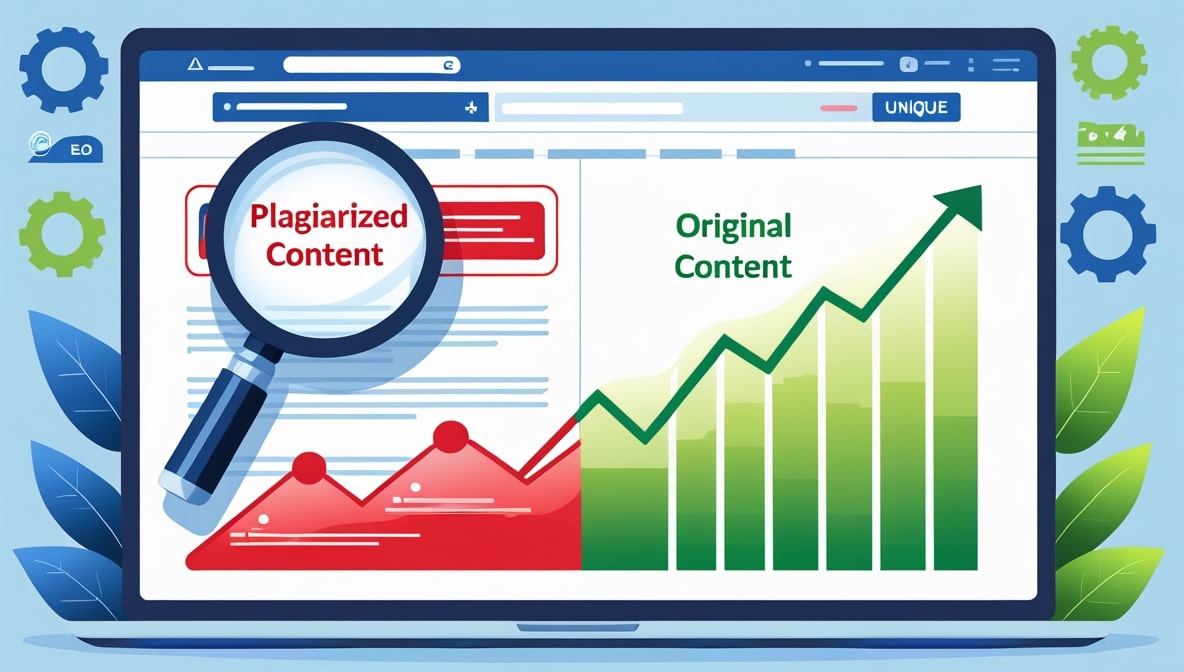
One of the most immediate and financially damaging consequences of plagiarized content is the impact on your search engine optimization, or SEO. Google's entire mission is to provide users with the best and most unique results for their queries. When its algorithms find two or more pages on the internet with the same, or very similar, content, it sees a problem. It will typically choose to rank only one of those pages usually the one it identifies as the original and the other "duplicate" versions will be pushed deep down in the rankings or filtered out of the results entirely.
This isn't some abstract technical problem; it translates to a direct loss of revenue. If your key service page or your top-performing blog post gets flagged as duplicate content, it can disappear from Google overnight. That means the traffic, the leads, and the sales that page was generating are gone.
A Local Example: When Your Colombo Tour Page Vanishes
Imagine you run a thriving travel agency right here in Colombo, and your most valuable online asset is your beautifully designed webpage for "The Ultimate Sri Lankan Cultural Tour." It ranks on the first page of Google and brings in a steady stream of high-quality leads. Now, imagine a new writer you hired to update that page inadvertently includes a few paragraphs of descriptive text that are too similar to a competitor’s site. Google’s algorithm detects this duplication. A few weeks later, you realize your page has vanished from the first three pages of search results. Your lead flow has dried up. That is the tangible, bottom-line cost of a single content mistake.
Your Digital Storefront and the Threat of Brand Damage
Your website is your digital storefront. It's often the very first interaction a potential customer has with your brand. What kind of first impression do you want to make? Do you want to be seen as a credible, authoritative, and trustworthy expert in your field? Or do you want to be seen as a business that cuts corners and presents unoriginal, borrowed work as its own?
Discovering plagiarized content on a company's website is the digital equivalent of walking into a luxury boutique and realizing they’re selling cheap knock-offs. It shatters credibility instantly. The trust that you’ve spent years and a fortune in marketing dollars to build can be wiped out in a single moment. This damage to your brand’s reputation can be far more costly and long-lasting than any temporary drop in search rankings.
Walking into a Legal and Financial Minefield
Now we move from brand risk to legal and financial risk. In an academic setting, plagiarism leads to a failing grade. In the business world, it can lead to a lawsuit. The content on your website is a commercial asset, used for commercial gain. If that content is found to infringe on someone else’s copyright, you are opening your business up to some very serious legal trouble.
This often starts with a cease-and-desist letter from the original content owner’s lawyer, demanding you take the content down. But it can easily escalate to demands for financial compensation for damages, or even a full-blown copyright infringement lawsuit, which can be incredibly expensive and time-consuming to fight. This is a five-alarm fire for any business, and it’s a risk that is shockingly easy to mitigate with a simple process change.
The Canary in the Coal Mine for Content Quality
Here’s something many managers don’t consider: plagiarism is often just a symptom of a much larger problem. That problem is low-quality, unoriginal, and uninspired content. Think about it. A writer who is paraphrasing a source too closely is a writer who hasn't done the hard work of synthesizing information, adding their own unique insights, or developing a fresh angle.
A plagiarism checker, in this sense, acts as a "canary in the coal mine." It doesn't just flag copied text; it often flags lazy content. A high similarity score can be a sign that the article is just a rehash of what's already out there and will likely fail to engage readers or perform well on its own merits. Using a checker can help you enforce a higher standard of originality and thought leadership across your entire content strategy.
The Simple Fix: A Small Step in Your Workflow
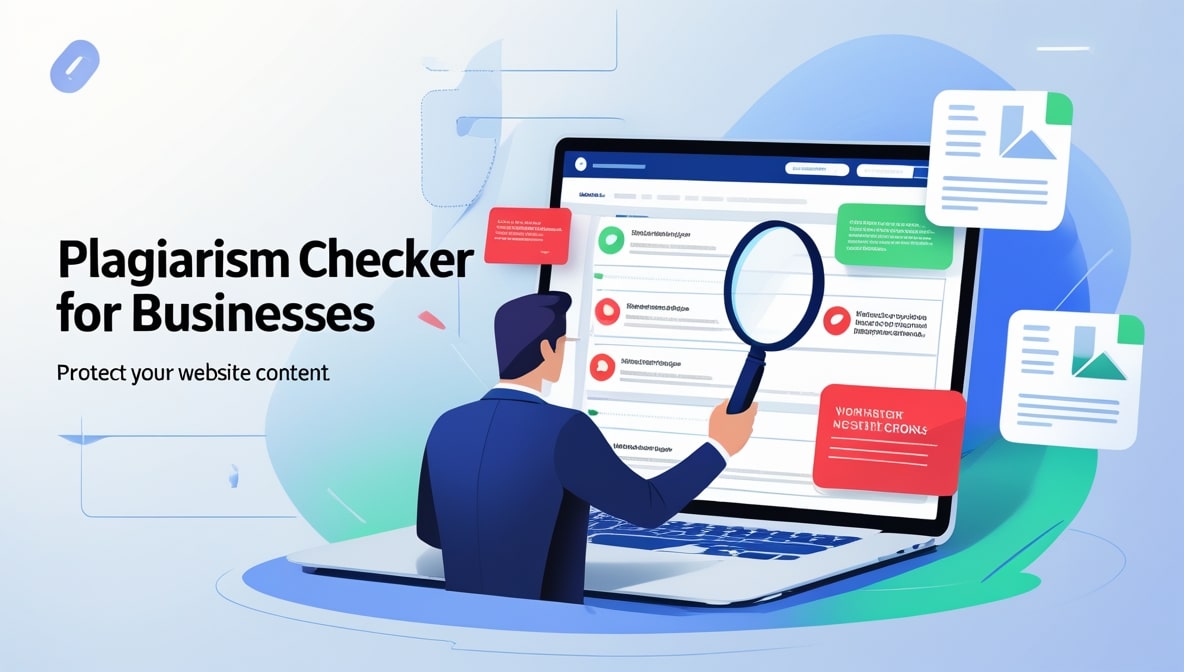
After hearing about all these catastrophic risks, you might think the solution must be complex and expensive. It’s not. The solution is as simple as adding one small, mandatory step to your content production workflow. It looks like this: a writer finishes a draft, it goes to an editor for style and grammar checks, and then, before it is approved for publishing, the final text is run through a plagiarism checker.
That’s it. It’s a final quality gate that every single piece of content must pass through, whether it was written by your in-house CMO or a brand-new freelance hire. This simple, scalable process is the single most effective way to protect your business from all the risks we’ve discussed.
The Easiest ROI Calculation You'll Ever Make
In business, every decision comes down to Return on Investment (ROI). So let's look at the ROI of a plagiarism checker. The potential cost of not using one is catastrophic: thousands, or even millions, in lost revenue from an SEO drop, irreparable brand damage, or crippling legal fees. The cost of using one is, by comparison, infinitesimally small. It’s a few extra minutes added to your workflow.
When you frame it that way, the decision becomes a complete no-brainer. It is an incredibly low-cost insurance policy against some of the most significant risks your digital brand faces.
The No-Brainer Solution for Smart Businesses
This is exactly why a tool like ours at plagiarism-checker.free is so valuable for businesses of all sizes. We provide a powerful, thorough, and reliable scan that can act as your final line of defense. Because our tool is so accessible, there is absolutely no financial barrier to implementing this critical quality control step. You can protect your business, enforce high standards of originality, and mitigate catastrophic risk without having to make a case to your finance department. It removes any and all excuses for not having this process in place.
It's More Than a Tool, It's Your Brand's Guardian
Your website and the content on it are among your most valuable business assets. You’ve invested countless hours and dollars into creating them. You wouldn’t leave the front door of your office or your store unlocked overnight. So why would you leave your digital storefront, your most public-facing asset, completely unprotected? A plagiarism checker is the simple, essential lock on that door. It's not a luxury or a "nice-to-have." It is a fundamental tool for risk management, brand protection, and intelligent business practice in the digital age.