How to Write 100% Original Articles for Better SEO
How to Write 100% Original Articles for Better SEO
You have your keyword. You’ve done your research. You open up a new tab, type it into Google, and your heart sinks just a little. The entire first page of search results is a wall of articles that look… well, exactly the same. They have slightly different titles, sure, and the pictures are swapped out, but the core ideas, the subheadings, the advice it’s all just a rehash of the same old stuff.
And you’re left with that paralyzing question: "What could I possibly have to say that hasn't already been said a million times?"
If you’re a blogger, a content marketer, or anyone trying to get their voice heard online, this is the daily struggle. It can feel like you’re shouting into a hurricane. But what if I told you that this sea of sameness is actually your greatest opportunity? In a world of digital echoes, the most powerful, most effective, and most sustainable strategy for better SEO isn't a technical trick or a keyword-stuffing hack. It's originality.
Let's Get One Thing Straight About Google
Before we dive into the creative process, we need to get on the same page about Google. Google's algorithm is incredibly complex, but its core mission is ridiculously simple: to provide the most satisfying answer to a user's query. Every update, from Panda to the latest helpful content rollouts, has been a step toward better rewarding content that genuinely helps people and demoting content that doesn’t.
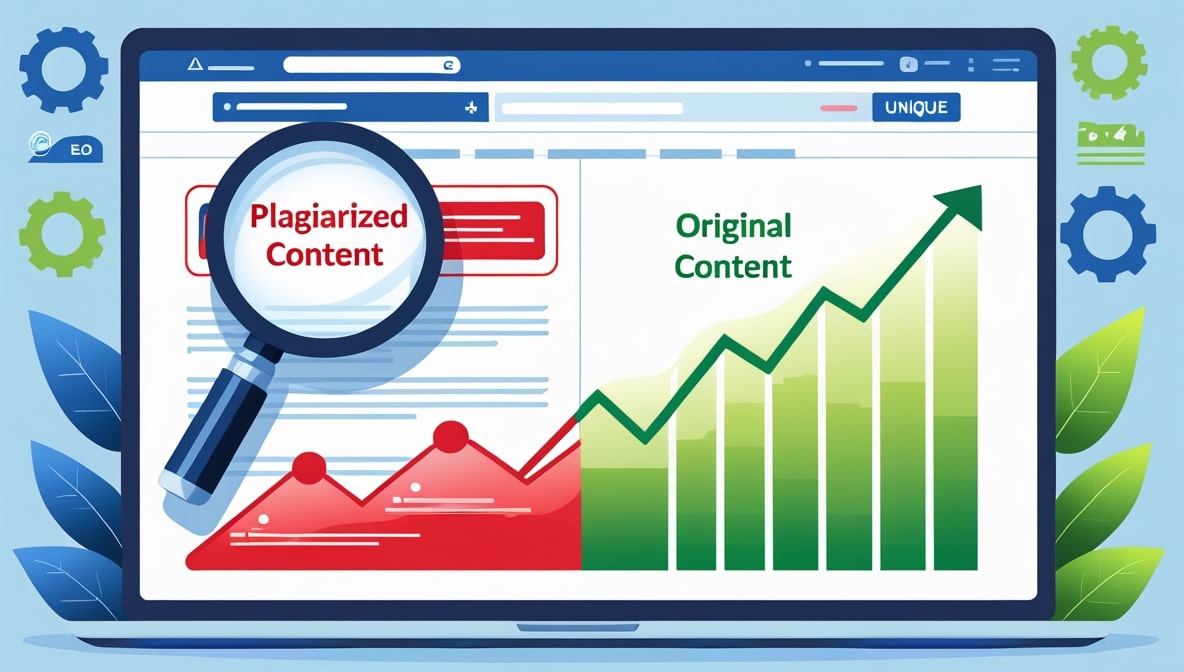
"Me-too" articles that just rephrase the top-ranking posts are the opposite of satisfying. They offer no new value. A user who clicks on three different links only to read the same advice three times is a frustrated user. And a frustrated user is Google’s worst nightmare. Therefore, content that is merely a copy or a slight rehash of existing work is, by its very nature, low-value in the eyes of a search engine that prioritizes user experience above all else.
Beyond Keywords: The Quest for Topical Authority
Modern SEO is about so much more than just matching keywords. It’s about building what’s called "topical authority." Think of it like this: Google doesn't just want to find one good article; it wants to find the true experts on any given subject. It wants to know who the real authorities are. And how do you prove you're an authority? You don't do it by repeating what everyone else has already said. You do it by offering unique insights, fresh perspectives, and information that can’t be found anywhere else.
When you consistently publish original, in-depth content, you're not just trying to rank for a single keyword. You're sending a powerful signal to Google that your website is a reliable and expert resource on that entire topic. Originality is the currency of authority.
It All Starts with Your Angle, Not Your Topic
So, how do you actually create something original when it feels like every topic is saturated? You start by realizing that originality is rarely about the topic itself; it's about your angle. Let’s take a wildly common topic, like "healthy breakfast ideas." A generic list of ten ideas is not original. It’s been done to death.
But what if you came at it from a unique angle? What if you wrote an article titled, "Five Healthy Breakfasts for People Who Absolutely Hate Mornings"? Or "The Science-Backed Breakfast That Will Actually Keep You Full Until Lunch"? Or even, "I Tried a Different Healthy Breakfast Every Day for a Month Here’s What Happened"? Suddenly, you have something interesting. Something unique. The topic is the same, but the angle is fresh. This is the first and most crucial step.
Escaping the Echo Chamber of Page One
Many writers make a critical mistake in their research phase. They treat the first page of Google search results as their primary source of information. They open the top ten articles and try to create a "better" summary of what’s already there. This is a recipe for creating another boring, "me-too" piece of content. You should absolutely read the top-ranking articles you need to know what your competition is and what Google is currently rewarding. But don't let your research end there.
To find truly original information, you need to dig deeper. Go to Google Scholar and look for actual academic studies related to your topic. Go to forums like Reddit or Quora and search for your topic. What are the real, unfiltered questions people are asking? What are the frustrations and pain points that the generic blog posts aren't addressing?
Finding Gold in Unexpected Places
Those online communities are a goldmine for originality. The top-ranking articles might all recommend "oatmeal with berries" as a healthy breakfast. But on a Reddit thread, you might find a dozen people complaining that oatmeal leaves them hungry in two hours, or that they’re tired of the same old recommendations.
This is your opening. You can write an article titled, "Tired of Oatmeal? Here Are Three High-Protein Alternatives That Are Just as Easy." You’re directly addressing a real-world frustration that you discovered by looking beyond the echo chamber of page one. You’re providing a unique solution, and that’s a powerful signal of value to both readers and search engines.
Your Most Unique Source: You
Here's a source of information that is 100% unique and that none of your competitors can ever hope to replicate: your own life. Your experiences, your stories, your opinions, your successes, and your failures are the ultimate wellspring of original content. Too many bloggers and businesses are afraid to be personal. They write in a sterile, corporate voice because they think it sounds more professional. In reality, it just sounds boring.
Don't just tell your readers how to do something; show them. Weave your own narrative into the content. People don’t connect with data; they connect with stories. Adding a personal touch is the fastest way to build a relationship with your audience and create content that is truly one-of-a-kind.
A Personal Story Makes All the Difference
Let’s go back to our breakfast example. Instead of just listing recipes, you could start the article with a short, relatable story. "For years, my morning routine was a chaotic mess. I'd hit snooze five times, chug a coffee, and grab a sugary granola bar on my way out the door. By 10 AM, I was starving, irritable, and completely unproductive. I knew something had to change, and that’s what sent me on a quest to find a truly satisfying, quick, and healthy breakfast."
Instantly, you’ve connected with every single reader who has ever had that exact same chaotic morning. Your article is no longer just a generic list; it's a journey that you are inviting the reader to join.
Synthesize, Don't Just Summarize
Another key skill for creating original content is learning to synthesize information, not just summarize it. Summarizing is when you simply report what your sources say. "Source A says this, and Source B says that." It's a book report. Synthesizing, on the other hand, is when you take information from multiple sources and create a new, original insight from it.
You look for the connections, the contradictions, and the patterns that others might have missed. A truly great article doesn't just present information; it presents a new way of thinking about that information. This is how you establish yourself as a thought leader, not just a reporter.
Weaving a New Narrative from Your Research
A writer who summarizes would say, "A 2022 study found that protein is good for satiety, and many nutritionists recommend eggs for breakfast." A writer who synthesizes would say, "While many popular diet blogs still push low-fat, carb-heavy options like oatmeal, the latest research from a 2022 study on satiety strongly suggests that the protein in eggs is actually far more effective at preventing a mid-morning energy crash. This means we may need to rethink our entire approach to a 'healthy' start to the day."
See the difference? The second example presents an argument. It takes existing information and uses it to build a new, original conclusion. That is high-value content.
The Foundational Skill of Ethical Paraphrasing
Of course, when you are incorporating all of this wonderful research into your work, you have to do it ethically. This means mastering the art of true paraphrasing. It’s not about changing a few words around; it’s about fully understanding the source's idea and then explaining it from scratch, in your own words and sentence structure, always accompanied by a proper citation or attribution. This foundational skill is the non-negotiable bedrock upon which all original, research-based writing is built. Without it, even the most original ideas can fall into the trap of plagiarism.
The Final Step: Verifying Your Originality
You’ve done all the hard work. You’ve found a unique angle, you’ve done deep research, you’ve injected your personal voice, and you’ve synthesized your findings into a truly original article. You’re ready to publish. But there’s one final, crucial step: verification. Even with the best intentions, it's possible for a phrase to be too close to a source or for an accidental oversight to occur.
Before you send your article out into the world, you need to be 100% confident that it is entirely your own. This is a non-negotiable part of a professional content creator's workflow. It protects your reputation and ensures that your content will be seen by Google as a truly unique asset.
A Professional's Final Quality Check
This is where a powerful plagiarism checker becomes an essential tool in your arsenal. Using a reliable service like the one we offer at plagiarism-checker.free is the final quality check that gives you complete peace of mind. You simply paste your final draft into the tool, and it will scan it against billions of sources across the web. It acts as your final set of eyes, catching any potential issues and allowing you to publish your work with the absolute confidence that it is 100% original.
Originality is the New SEO
In the crowded, noisy world of online content, the old SEO playbook is dead. You can’t win by tricking algorithms or by being the tenth person to say the same thing. You win by being the one voice that offers something different, something real, something valuable. Originality isn't just an ethical guideline anymore. It is the very heart of modern, effective SEO. So go find your angle, tell your story, and create something that only you can create. That's how you get noticed.