How to Use Plagiarism-Checker AI Detector
How to Use Plagiarism-Checker AI Detector
It's a little past eight-thirty on a Monday morning here in Colombo. The new work week is officially underway, the city is buzzing with its unique energy, and for many of us, our focus is turning to the content that will define our week. We are living and working in the incredible, and sometimes slightly confusing, world of 2025. It’s a world where our creative toolkit has expanded to include powerful artificial intelligence assistants. This is amazing, but it also means we have a new, essential skill to learn: how to tell the difference between human-written and AI-generated text.
You might be an educator who needs to verify the authenticity of a student’s work, an editor ensuring a consistent brand voice, or a content manager upholding your site's quality standards. For all of us, the AI detector has become a necessary new tool. But how do you actually use one effectively? What’s the process? And how do you interpret the results in a fair and ethical way? Let’s walk through the simple, step-by-step process of using a modern AI checker, turning this powerful and sophisticated technology into your simple, trusted, everyday assistant.
First, Let's Quickly Recap What We Are Looking For
Before we jump into the "how," it’s really helpful to just quickly remember the "what." A good, modern AI detector isn't just doing a simple search for copied words. That’s what a traditional plagiarism checker does. An AI detector is a much more sophisticated and nuanced tool. It is, itself, an AI that has been carefully and extensively trained to recognize the subtle, statistical "fingerprints" that AI writers, like the famous ChatGPT or Google's Gemini, often leave behind in their text. It’s looking for very specific patterns in word choice, in sentence structure, and in the overall rhythm and flow of the writing. Our goal in using the tool is to get a clear and reliable signal about whether or not those patterns are present in a piece of text.
Step One: Preparing Your Text for a Clean and Accurate Analysis
The very first step in this whole process, before you even open your web browser, is to have the text that you want to check ready to go. This could be a student's essay that has just been submitted, an article that you’ve received from a freelance writer, or even your own AI-assisted draft that you are analyzing as part of your editing process. To get the cleanest and most accurate result, you should make sure you have the complete, final version of the text open in a separate window, ready to be easily copied. A clean and complete start makes for a clean and complete analysis. The tool is powerful, but it can only analyze what you give it.
Step Two: Your Simple, Clean, and Uncluttered Workspace
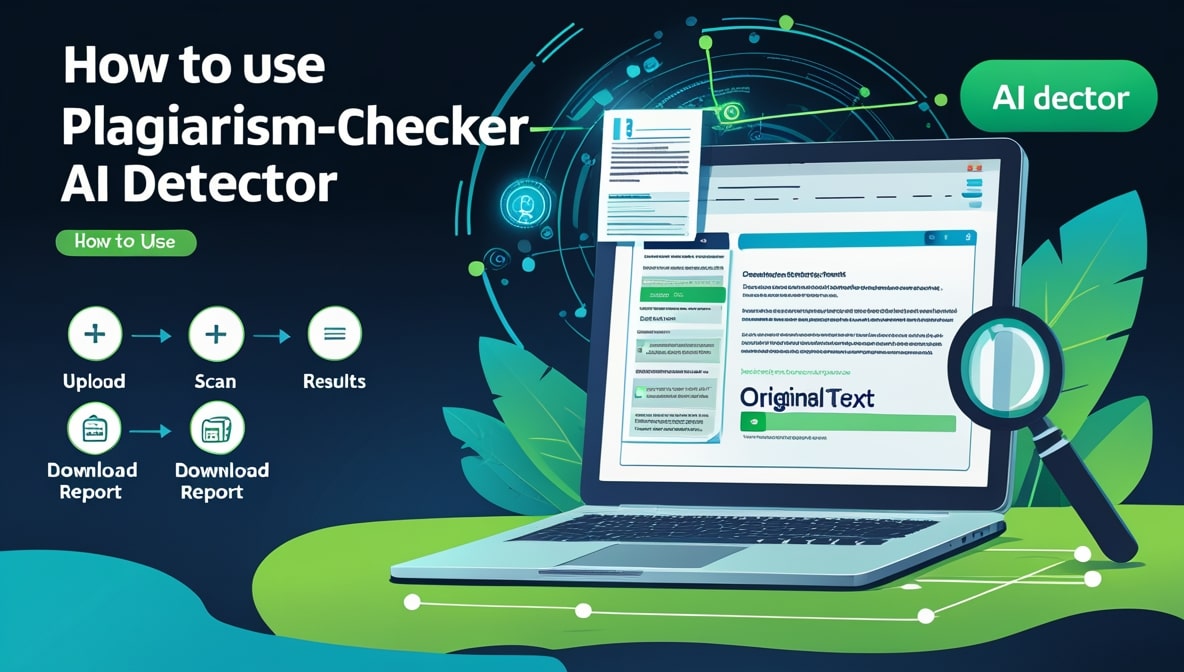
Now, you can open your web browser and head over to a clean, simple, and user-friendly tool like Plagiarism-checker.free. One of the first things you’ll notice, and appreciate, is the complete lack of clutter. You don’t need to navigate through a dozen confusing menus or close a bunch of annoying pop-up ads. You will be greeted by a big, clean, and inviting text box. This intentional simplicity is designed to make the process as calm and as stress-free as possible. The next step is as simple as it sounds. You just go back to your prepared document, you copy the entire text, and you paste it directly into this waiting box.
Step Three: The Magic Button That Starts the Deep Analysis
Okay, your text is now sitting there in the box, ready to be analyzed. Now comes the moment of truth, and it really couldn't be any simpler or more straightforward. You’ll see a clear and obvious button, usually located right below the text box, that says something like "Detect AI". You just give that button a confident click. This single, simple click is what sets the powerful and sophisticated AI engine into motion. It’s like handing your document over to a super-smart digital detective and saying, "Could you take a quick look at this for me?" This is the moment where the tool gets to work on your behalf.
What's Happening in Those Few Seconds of Waiting?
While you're waiting for just a few moments, what's actually happening in the background is pretty incredible. The tool's specialized AI is instantly breaking down your entire document into its core linguistic components. It’s analyzing its statistical properties, looking at things with fancy names like "perplexity" (how predictable the word choices are) and "burstiness" (the variation in sentence length). It’s comparing these deep, underlying patterns to the millions and millions of examples of both human and AI-generated text that it was trained on.
It’s performing this incredibly complex analysis and calculating, in real-time, the statistical probability that the text you have provided was written by a human or generated by one of the large language models.
Step Four: Understanding Your Clear and Simple AI Detection Report
When the complex analysis is complete, you’ll be presented with your report. A good, user-friendly tool will make this report incredibly simple and easy to understand. You won’t be buried in a mountain of confusing technical data. Instead, you’ll likely see a very clear, top-line result, which is often presented as a probability score. It might say something like "98% Probability of Human-Written Content" or it might give you a more direct assessment like "High Likelihood of AI Generation.
Some of the most advanced tools might even use a system of color-coded highlighting on the text itself, showing you which specific sentences have the strongest and most obvious AI-like patterns. This gives you both the big picture and the specific details you need to investigate further.
The Golden Rule: How to Interpret Your Results Ethically and Fairly
This is the most important, most crucial, and most ethical part of this entire guide. It is absolutely essential to remember that the result you get from an AI detector is a highly accurate statistical probability; it is not a definitive, absolute, and infallible verdict. It is a powerful and very reliable signal, but it is not a "guilty" or an "innocent" judgment.
It is an invaluable and insightful piece of data that you should always use as the starting point for a deeper, human-led review or a constructive and open conversation. It is a powerful tool for inquiry, not for instant and automatic accusation. This ethical and responsible approach is absolutely critical when using this new technology.
A Real-World Example: An Editor's Workflow in Modern Colombo
Let's imagine an editor who is working for a popular online lifestyle magazine right here in Colombo. She receives an article from a new freelance writer. The writing is good, the facts are correct, but it lacks a certain personal spark or a unique voice. She has a hunch. So, she runs the text through the AI detector on Plagiarism-checker.free. The report comes back showing a very high probability of AI generation. Now, she doesn't just reject the article and blacklist the writer.
Instead, she uses this report as a powerful coaching tool. She can call the writer and have a constructive conversation, saying something like, "The foundation of this article is good, but the AI detector suggests that it might be a little too generic. Can you go back and add more of your own personal anecdotes, your own unique experiences, and your own authentic voice to make it truly special?" The tool has just facilitated a constructive and highly educational conversation.
The ability to use a modern AI detector wisely and ethically is quickly becoming a new and essential skill for every single teacher, every editor, every content manager, and every professional in 2025. It’s all about learning how to navigate a new and evolving technological landscape with the best possible tools and a responsible and thoughtful mindset. The process, as we've seen, is incredibly simple. It’s a matter of a few easy steps that absolutely anyone can master in a matter of minutes. By using a free, accurate, and user-friendly tool like Plagiarism-checker.free, you are empowering yourself with the clarity that you need to uphold your high standards of authenticity and to champion the unique, irreplaceable, and incredibly important value of the true human voice in the work that you do.