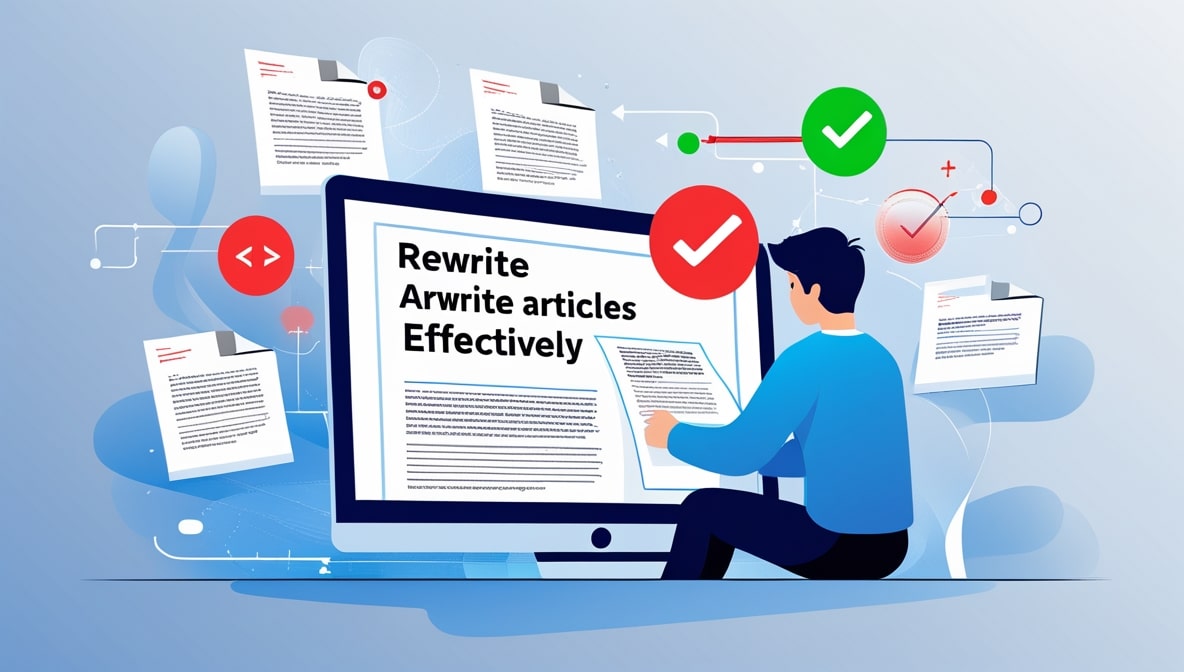
How to Rewrite an Article Without Losing Meaning
How to Rewrite an Article Without Losing Meaning
You’ve found it. The perfect source. It’s a dense research paper, a comprehensive guide, or an old blog post that contains the exact information you need. The ideas are brilliant, the data is solid, but the presentation… well, it’s not quite right for your audience. Maybe it’s too academic, too long, too outdated, or just written in a style that doesn’t match your own. So, you have a task ahead of you: you need to rewrite it.
And that’s where the nervous feeling starts to creep in. How do you capture the essential meaning of the original piece without just changing a few words around? How do you lean on its structure for guidance without creating a cheap copy? It’s a fine line to walk. On one side is a skillful, ethical transformation of ideas. On the other side is the treacherous territory of plagiarism.
But it doesn't have to be a guessing game. There is a professional process, a step-by-step method that allows you to confidently rewrite an article, preserving its core message while creating something that is truly new, valuable, and most importantly ethically sound.
Before You Write a Word: Define Your "Why" and "Who"
This is the most critical step, and it’s the one most people skip. Before you even think about the words on the page, you have to define the entire purpose of your rewrite. Ask yourself two simple questions: First, why am I rewriting this? Second, who am I rewriting this for? The answers to these questions will be your compass for the entire project.
Let's say you've found a dense, 50-page scientific study on the metabolic effects of intermittent fasting. Your "why" might be to make this complex information accessible and actionable for the average person. Your "who" would be readers of a health and fitness blog who are not scientists. Right away, you know your rewrite needs a simpler vocabulary, a more engaging tone, and a focus on practical takeaways, not just theoretical data. This initial clarity is what separates a thoughtful rewrite from a pointless content-spinning exercise.
Step One: Become an Expert on the Original
Now that you have your mission, it’s time to engage with the source material. But your goal here isn't to start picking out sentences to change. Your goal is to become a temporary expert on that one article. Read it through once to get the general gist. Then read it again, this time with a highlighter or taking notes. What is the single, overarching argument the author is making? What are the main pieces of evidence they use to support that argument?
Don't fixate on the specific phrasing or the beautiful prose. You are not a tourist admiring the architecture of the house. You are an engineer trying to understand its structural blueprint. Your job is to internalize the logic and the core message so well that you could explain it to someone at a coffee shop without needing to look at the article itself.
Deconstruct It: Find the Article's Skeleton
Once you feel you have a deep understanding of the original piece, do the most important thing you can possibly do: close it. Put it away in another tab or another room. Now, on a blank piece of paper or in a new document, create a simple outline of the article you just read. This is the deconstruction phase.
Don't write in full sentences. Just jot down the skeleton. What was the main thesis or conclusion? What were the three or four major supporting points or sections? What was the logical flow from one point to the next? By extracting this bare-bones structure, you are separating the essential meaning from the specific language the original author used to express it. You've now isolated the ideas, which is what you want to work with.
Step Two: Build Your Own Blueprint
You have the skeleton of the original article. Now it’s time to be an architect. Looking only at your skeletal outline, start building a new blueprint for your own article. This is where your originality truly begins to take shape, guided by the "why" and "who" you defined at the start.
Maybe the original scientific study saved its practical applications for the very end. For your fitness blog audience, you might decide to create a new outline that starts with those practical tips. You can reorder the supporting points to make more sense for a layperson. You can simplify the logic or combine two complex points into one easier-to-digest section. You are consciously deciding on a new structure that will best serve your new purpose.
Adding Your Unique Value
Your new blueprint is also your opportunity to decide where you will add new value. An ethical rewrite is never just a 1-to-1 translation; it’s an enhancement. Looking at your new outline, where can you inject your own flavor? Can you add a personal anecdote that illustrates the main point? Can you include a more recent statistic that builds upon the original’s data? Can you create a new analogy or metaphor that makes a complex idea click for your readers?
This is how you make the article your own. You are using the original’s core message as a foundation, but you are building a new, improved structure on top of it, complete with your own unique contributions.
Step Three: Write with the Blinders On
You have your new blueprint. It's detailed, it's tailored to your audience, and it includes your own unique additions. Now, and only now, do you start writing your first draft. And here is the golden rule: as you write, look only at your new outline. Do not, under any circumstances, open up the original article and have it side-by-side with your draft.
This is the only way to truly break free from the original author's voice and sentence structure. By forcing yourself to write from your own structural plan, you are compelling your brain to find new words, new transitions, and new ways of explaining the concepts. You are writing from your understanding of the ideas, not from the memory of the original text.
The Giant Asterisk: You Must Give Credit
This is the part that is absolutely non-negotiable. Rewriting an article is, in essence, a highly advanced and comprehensive form of paraphrasing. You are borrowing the core intellectual framework from the original author. To present this work as entirely your own would be a serious act of plagiarism, even if every single sentence is different. You must provide clear and honest attribution.
This doesn't have to be a clumsy, academic citation (unless that's appropriate for your context). It can be woven gracefully into your text. For example, you could open your article by saying, "In this post, I'm going to break down the groundbreaking research on intermittent fasting originally published by Dr. Evelyn Reed in the Journal of Metabolic Science." Or you can attribute ideas within the text, with phrases like, "The core concept here, first outlined by Dr. Reed, is that..."
Weaving Attribution into Your Narrative
Being transparent about your sources doesn’t weaken your article; it strengthens it. It shows that you've done your research and are building upon the work of credible experts. It adds a layer of authority and tells your reader that you are a trustworthy curator of information. Never be afraid to give credit. It’s a sign of a confident and ethical writer. Your value is not in pretending you came up with the original idea, but in your unique ability to translate and enhance it for a new audience.
Step Four: The Side-by-Side Comparison
You’ve finished your first draft. You’ve written it from your own outline and included clear attribution. Now, for the first time since the deconstruction phase, you can finally open the original article again. It’s time for a final review, and you're looking for two things.
First, check for meaning. Read your article, then re-read the original. Did you successfully preserve the core message, the essential facts, and the nuance of the original argument? Did you misunderstand or misrepresent anything? This is your chance to correct any errors and ensure your transformation was faithful to the original's intent.
Hunting for Accidental Similarities
Second, you need to check for originality. This is where you put your sentences under a microscope. Read a paragraph from your article, then read the corresponding section from the original. Even with the best intentions, you might have accidentally used a unique turn of phrase or mirrored a sentence structure too closely. Our brains are funny like that. This is your chance to hunt down those "ghosts" of the original text and revise them one last time to ensure your wording is truly your own.
The Final, Objective Test of Originality
Let’s be honest: checking your own work for accidental plagiarism can be tough. You’re too close to it. You might not see similarities that would be obvious to an outsider or, more importantly, to a plagiarism detection algorithm. After you’ve done your own manual comparison, the final, crucial step is to get an objective, unbiased opinion from a powerful, automated tool.
This is the ultimate safety net that protects you and your reputation. By running your newly rewritten article through a reliable plagiarism checker, you can get a comprehensive report that highlights any passages that are still too similar to existing content online.
Your Ultimate Safety Net Before Publishing
Using the tool we’ve built at plagiarism-checker.free is the perfect final step in this professional workflow. Just paste the complete text of your new article into the checker. It will scan it against billions of sources, including, most likely, the original article if it's published online. The report will show you if any of your rewritten sentences are still algorithmically too close to the source material, giving you a clear, final to-do list for revision. It’s the step that provides 100% confidence to hit "publish."
More Than a Rewrite, It's a Transformation
Rewriting an article without losing its meaning is a skill that takes practice, but it's one of the most valuable skills a writer can possess. It’s not about "spinning" content or finding a lazy shortcut. It’s about acting as a translator and a value-adder. When you follow a deliberate process of deconstruction, reconstruction, and ethical attribution, you can transform existing ideas into something new, exciting, and incredibly valuable for your audience.