How Teachers Detect Plagiarism in Assignments and Projects
How Teachers Detect Plagiarism in Assignments and Projects
You hit the "submit" button. Your essay, the product of late nights and a whole lot of caffeine, is gone sent off into the digital ether of your university’s portal. And now you wait. For many students, what happens next is a complete mystery. The assignment goes into a sort of black box, and a few weeks later, a grade comes out. You might imagine your professor quickly skimming it, marking a few commas, and assigning a grade. Simple as that.
But what if I told you there’s a lot more going on? What if I told you that every teacher, from your high school English instructor to your university professor, is also part-detective? They’ve developed a keen sense, a set of skills honed over years of reading thousands of student papers, for spotting work that isn't quite right. And that’s before they even touch the powerful software at their fingertips.
So, let's open up that black box. This isn't about learning how to cheat the system. It's about understanding the system so you can appreciate why originality is so important, and how you can submit your work with absolute confidence. Here’s the inside scoop on how your teachers really detect plagiarism.
The First Tool is Always the Human Brain
Long before any fancy software gets involved, the first line of defense against plagiarism is your teacher’s own experience and intuition. They are not just passively reading your words; they are actively analyzing them, and there are several telltale signs that even the most inexperienced instructor learns to spot very quickly. These are the human clues that often trigger a deeper investigation.
The truth is, your professors are experts in their field and, just as importantly, they are experts in reading student writing. They can often sense when something is amiss just from the rhythm and feel of the paper. It's a skill that no algorithm can fully replicate, and it's why many cases of plagiarism are first suspected, if not entirely discovered, by the teacher alone.
A Sudden Change in Voice or Tone
This is probably the single biggest and most obvious red flag for any teacher. Your writing has a voice. It has a certain style, a typical vocabulary, and a natural flow. Your teacher gets used to that voice over the course of a semester. Now, imagine they’re reading your essay. The first two paragraphs sound just like you clear, straightforward, maybe a little informal. Then, suddenly, the third paragraph arrives.
The language abruptly shifts. The sentences become long and complex, filled with dense academic jargon and words you’ve never used in class. It sounds less like a student and more like a tenured professor who has been studying this topic for thirty years. To a teacher, this sudden shift in voice sticks out like a sore thumb. It’s the literary equivalent of a person speaking in a calm voice and then suddenly shouting in a completely different accent. It’s jarring, and it’s an immediate signal to start looking closer.
Your Professor Knows Your Writing Style
Beyond the general "voice" of a paper, your professor gets to know your specific writing habits. They know your common grammatical quirks maybe you always struggle with comma splices or you overuse certain transition words. They know your level of understanding of the course material. They’ve seen your work on quizzes, in discussion posts, and on previous, smaller assignments.
So, when you turn in a final paper that is suddenly, miraculously, flawless with perfect grammar, an incredibly sophisticated argument, and a deep understanding of concepts you’ve struggled with all semester it raises a question. While it’s possible you’ve had a massive breakthrough, it's also a strong indicator that the work might not be entirely your own. A paper that is too perfect is often just as suspicious as one with glaring errors.
They've Read It All Before
This is especially true at the university level. Your professor is likely a leading expert in their specific field. They didn't just start learning about this topic when the semester began; they’ve dedicated their professional lives to it. They have read not just the key articles and books on the subject, but probably hundreds, if not thousands, of student essays on the exact same topic you're writing about.
They know the major sources inside and out. They know the common arguments students make and the typical ways they phrase them. So when they’re reading your paper and come across a beautifully articulated point, there's a good chance they recognize it immediately. They might think, "Ah, that's a perfect summary of Dr. Gupta's 2018 paper," because they've read that paper a dozen times. No software needed.
The Telltale Ghosts in the Machine: Formatting Errors
Here’s a classic, almost comical, sign of a rush copy-and-paste job. When you copy text from a website or a PDF and paste it into your Word or Google Doc, you often bring along some invisible formatting code with you. To a teacher’s trained eye, these formatting ghosts are a dead giveaway.
Maybe the font suddenly changes from Times New Roman to Calibri for a single paragraph. Or the font size shifts from 12-point to 10.5-point. Sometimes the text color is subtly different a charcoal gray instead of pure black. One of the most common signs is a faint gray or colored background behind a block of text that the student didn't notice. Or even words that are still hyperlinked, just without the blue, underlined formatting. These tiny inconsistencies scream that the text originated somewhere else.
Clues from Outdated or Irrelevant Information
Good writing shows critical engagement with the material. Plagiarized writing often reveals a complete lack of it. A teacher can often spot copied content based on the information itself. For example, imagine it's October 2025, and you’re a student in Colombo writing about social media trends. If your paper breathlessly discusses a "new and emerging platform" that was actually popular in 2016, it's a clear sign you’ve lifted the text from an old article without thinking.
Similarly, using information that is geographically or culturally irrelevant can be a clue. A paper for a Sri Lankan history class that uses examples exclusively from American history, or a business report for a local Colombo market that cites statistics from Canada, suggests that the content was pulled from a convenient source, not thoughtfully researched for the specific assignment.
The Simple Power of a Ten-Second Google Search
Even before escalating to official university software, teachers have the same powerful tool at their disposal as everyone else: a search engine. If a sentence or paragraph feels suspicious, all your professor has to do is copy that snippet of text, paste it into Google with quotation marks around it, and hit enter.
More often than not, this simple, ten-second action is all it takes. The search results will instantly show the original source, whether it’s a popular blog, an online encyclopedia, or a published academic paper. This is often the first step a teacher will take when their internal "plagiarism detector" goes off, and it’s incredibly effective at confirming their suspicions.
When the "Big Guns" Come Out: Detection Software
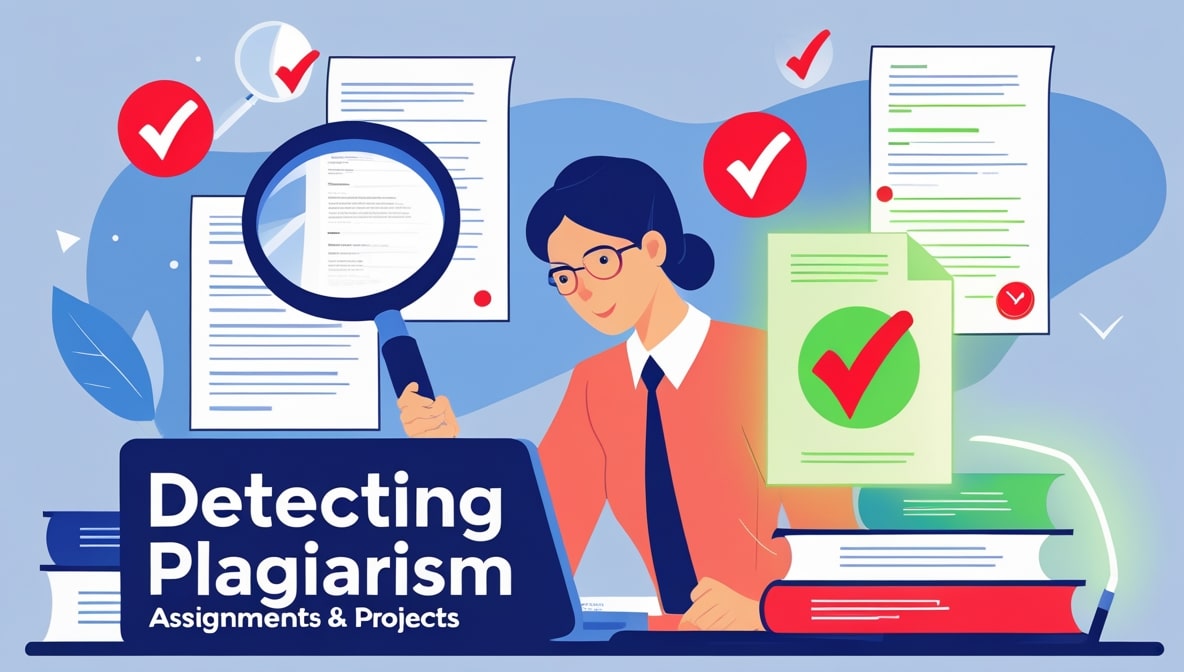
Of course, in today's academic world, most institutions provide their faculty with powerful plagiarism detection software like Turnitin or SafeAssign. When you submit your paper to your university's online portal, it is often automatically scanned by one of these tools. These programs compare your document against a massive, ever-growing database containing billions of web pages, academic journals, books, and, crucially, every other student paper that has ever been submitted to the system.
A few hours later, your professor receives a "Similarity Report" for your paper. This report includes an overall percentage score, which represents how much of your text matches content in the database.
Demystifying the "Similarity Score"
Now, this is where many students get anxious. They see that percentage score as a final verdict. But that’s not how teachers use it. A good professor knows that the percentage itself doesn't tell the whole story. For example, a paper might have a 20% similarity score, which sounds high. But upon inspection, that 20% might be entirely made up of properly quoted material in quotation marks and a correctly formatted bibliography. That's not plagiarism; that's good research.
Conversely, a paper might have a low score, like 5%, but if that 5% is one single, crucial paragraph lifted verbatim from a source without any citation, that is a serious case of plagiarism.
What Teachers Really Look for in the Report
Your professor doesn't just look at the number. They open the detailed report, which provides a color-coded, side-by-side comparison of your paper and the original sources. They aren't looking for common phrases or correctly cited quotes. They are looking for the real signs of academic dishonesty: large, uninterrupted blocks of matching text from a single source that have no quotation marks and no citation. They are looking for patterns of "patchwriting." The report is not the judge and jury; it is the evidence that the teacher uses to make an informed, professional judgment.
So, How Can You Stay Off the Radar?
Reading about all these detection methods can be nerve-wracking. But the takeaway isn't to find better ways to hide your tracks. The takeaway is that trying to take shortcuts with your writing is a high-risk, low-reward gamble. The goal is to write with such integrity that you never have to worry about any of this. And the smartest way to do that is to be proactive and to check your own work before you submit it.
Think of it like this: you proofread for typos, right? You should also "proofread" for originality. It's a final quality control step that puts you in the driver's seat of your own academic integrity.
The Smartest Move: Check Your Own Work First
Before you hand your paper over to your professor and their arsenal of detection tools, you should first see what they are going to see. Using an accessible and reliable plagiarism checker gives you the chance to be your own detective. You can catch those honest mistakes the forgotten quotation marks, the paraphrase that ended up too close to the original, the citation you accidentally deleted before they become a problem.
This is exactly why a tool like ours at plagiarism-checker.free is so valuable for students. It gives you access to the same type of technology your teachers are using. You can paste your essay in, get a clear report on any matching text, and then make any necessary revisions. It's not about cheating; it's about being diligent and responsible.
It's About Learning, Not Just Passing
At the end of the day, your teachers aren't on a witch hunt. The reason they care so much about originality is that the entire purpose of an assignment is to see your thoughts, your analysis, and your understanding of the material. That’s how learning is measured. When you submit someone else's work, you are robbing yourself of that learning opportunity. The detection process isn't there to punish students, but to protect the value of a genuine education. By understanding how it works, you can better appreciate the profound importance of making your work authentically, confidently, and proudly your own.