How Plagiarism Affects Your Academic or Professional Reputation
How Plagiarism Affects Your Academic or Professional Reputation
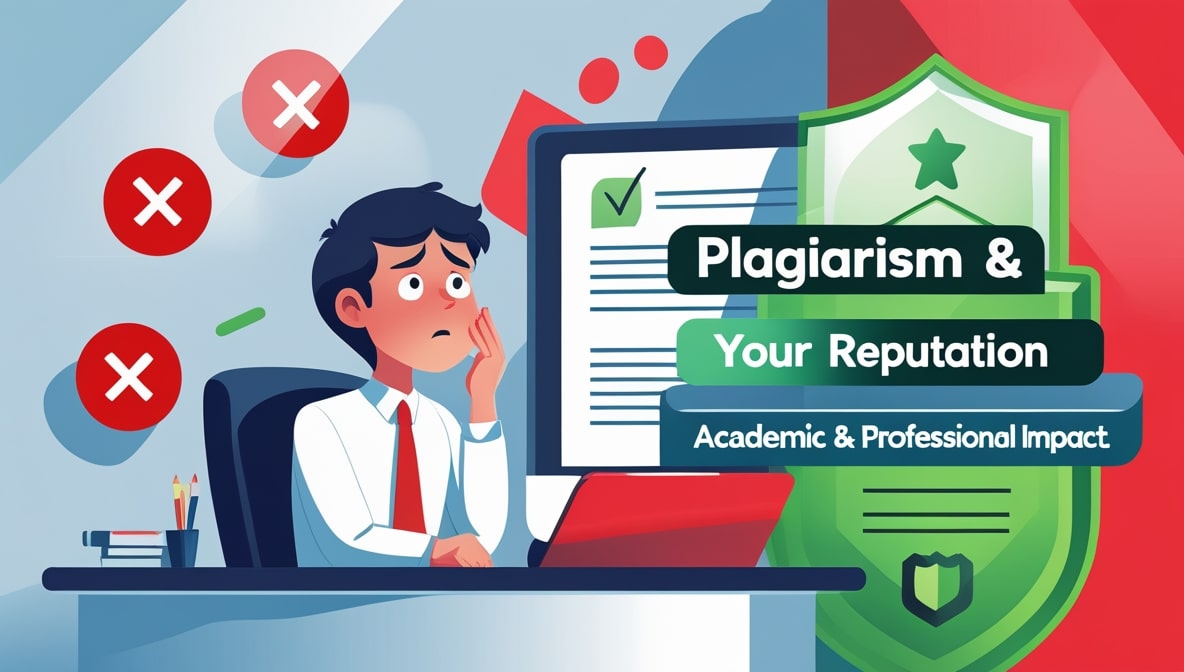
Think about your reputation for a moment. What is it, really? It’s this invisible, incredibly valuable thing that you build, piece by piece, over years. Every assignment you turn in, every project you complete, every article you publish each one is a brick. With enough time and effort, you construct an impressive building that represents your credibility, your skill, and your integrity. It’s your personal brand, the sum of all your work.
Now, imagine a wrecking ball. One that can demolish that entire structure in a single, devastating swing. That’s plagiarism.
We often talk about the immediate consequences of plagiarism, like a failing grade on a paper or an SEO penalty on a website. But those are just the initial tremors. The real damage, the earthquake that can alter the entire landscape of your future, is the catastrophic blow to your reputation. And whether you’re a student just starting out or a seasoned professional, it’s an asset you simply can’t afford to lose.
It's Not Just About the Grade, It's About Your Record
In the academic world, the first thing people worry about is failing an assignment or a course. And yes, that’s almost a certainty. But frankly, that’s the least of your worries. When a student is caught plagiarizing, it’s rarely just a quiet conversation and a zero in the gradebook. It triggers a formal process, one that can leave a permanent mark on your academic record.
Many universities have a "zero tolerance" policy. A finding of academic dishonesty can result in a notation on your official transcript, a document that follows you for the rest of your life. Imagine applying to graduate school, law school, or for a competitive scholarship. You have the grades, you have the test scores… but there, in black and white, is a formal sanction for plagiarism. What does that say to an admissions committee about your character and your ability to produce honest, original research? It’s a red flag that can disqualify even the most brilliant candidate.
The Trust You Can't Get Back
Beyond the official record, there’s a more personal, and perhaps more damaging, consequence: the complete erosion of trust with your mentors. Your professors are more than just teachers; they are the gatekeepers to your future academic and professional life. They write the letters of recommendation that get you into grad school. They connect you with internships. They nominate you for awards.
When you plagiarize, you don’t just cheat on an assignment; you betray that relationship. A professor who catches you in an act of academic dishonesty will never look at you the same way again. How could they possibly write a glowing recommendation attesting to your character and ability? They can’t. That bridge is burned, and with it, a network of opportunities vanishes into thin air. You become academically isolated, and that’s a very difficult position to recover from.
Facing the Music: The Disciplinary Hearing
Let’s be clear about what often happens. A serious plagiarism case isn’t handled by your professor alone. It gets escalated to a university disciplinary committee or an academic integrity board. This isn't a casual chat. It's a formal hearing where you have to stand before a panel of faculty and administrators and account for your actions. It’s an intensely stressful and humbling experience.
The outcomes of these hearings can range from a formal warning to suspension for a semester or even permanent expulsion from the institution. Think about that for a second. Years of hard work, tuition, and effort, all potentially wiped out by one poor decision, one moment where taking a shortcut seemed easier than doing the work. The immediate grade is temporary, but the memory and the consequences of that hearing can follow you for a very long time.
Entering the Professional World: Where Trust is Currency
If the stakes are high in academia, they are monumental in the professional world. As you move into your career, your reputation becomes the absolute currency you trade on. Whether you’re a journalist, a marketer, a scientist, a lawyer, or a business consultant, your clients and colleagues need to trust that your work is authentic and your word is good. Plagiarism obliterates that trust instantly and often, irrevocably.
In professions that are built on the written word like journalism, marketing, or publishing originality isn’t just a rule; it’s the entire job. Your name is your brand. When a journalist is found to have plagiarized sources, they are almost always fired. But it doesn't stop there. Their name becomes toxic. Every future employer will Google them, and that scandal will be the first thing that appears. It can be a career-ending event.
When Your Name Becomes a Liability
We’ve all seen the headlines about famous authors or high-profile journalists whose careers imploded overnight because of plagiarism accusations. But this isn't just a problem for the famous. Imagine you’re a freelance graphic designer. You use a piece of someone else's art in a logo for a client without attribution. When it’s discovered, not only do you lose that client, but word spreads. Your name becomes associated with theft. Who would hire you after that?
Or consider a research scientist. If they are found to have plagiarized parts of a study, their paper is retracted from the scientific journal. This is a mark of profound shame in the scientific community. It calls into question all of their previous work and makes future collaboration or funding nearly impossible to secure. Your name, once an asset, becomes a liability.
The Ripple Effect in a Business Environment
You might think that in a typical corporate office, the stakes are lower. They’re not. Let’s say a junior marketing associate is tasked with creating a competitive analysis report for a major client pitch. Under pressure, they copy and paste entire sections from online articles. The pitch goes well, and the company wins the client. But what happens a few months later when the client discovers the report was plagiarized?
The fallout is immense. The client loses all faith in the company, likely terminating the contract. The company's reputation is damaged. And the employee? They’re fired, and they now have to explain in future interviews why they were let go. A single person’s shortcut can create a devastating ripple effect that harms an entire team and a company’s bottom line.
The Lingering Ghost of a Digital Footprint
Perhaps one of the most terrifying aspects of a reputational scandal in the 21st century is its permanence. The internet never forgets. A news article detailing a journalist's firing, a university's public statement about a retracted thesis, a blog post exposing a marketer’s copied content these things are indexed by search engines and can remain online forever.
That single mistake you made as a twenty-year-old could easily show up in a routine background check for a job ten or fifteen years down the line. It becomes a digital ghost that follows you, a constant explanation you have to provide for a lapse in judgment you made a lifetime ago. The short-term gain of saving a few hours of work is simply not worth the price of a permanent digital stain on your name.
The Damage You Don't See: The Internal Toll
Beyond all the external consequences, there's a quieter, more insidious damage that plagiarism inflicts: the damage to your own sense of self. When you decide to use someone else’s words or ideas instead of your own, you are, on a subconscious level, telling yourself a story. You're telling yourself that your own thoughts aren't good enough, that your own voice doesn't have value, and that you're not capable of doing the work.
This can breed a deep-seated imposter syndrome. You live with the low-humming anxiety of being "found out." Every success feels hollow because you feel like you didn't truly earn it. This internal toll, this erosion of your own self-confidence, can be one of the most debilitating long-term effects of academic and professional dishonesty.
Your Reputation is Your Most Valuable Asset
When you look at the whole picture, it becomes clear. Your reputation is the single most valuable asset you will ever build. It’s more important than any one grade, any one deadline, or any one job. It is the foundation upon which your entire academic and professional life is built. And because it's so valuable, it’s something that must be actively and consciously protected.
Building a reputation for integrity means making a commitment to originality in everything you produce. It means embracing the challenge of developing your own ideas and finding your own voice, even when it’s difficult. It means understanding that the process of doing the work is actually more important than the final product itself, because that process is what builds real skill and lasting confidence.
An Insurance Policy for Your Credibility
So how do you protect this priceless asset? You do it by being diligent, honest, and thorough. And you do it by using the tools available to you to ensure your work is beyond reproach. In today’s world, using a high-quality plagiarism checker before you submit any important piece of work is not a sign of weakness; it’s a sign of professionalism.
Think of it as an insurance policy for your reputation. Just as you’d have a trusted mechanic inspect a car before you buy it, you should have a trusted tool inspect your work before you publish it. It’s the responsible final step that catches any accidental oversights, a forgotten citation, or a paraphrase that’s a little too close to the source. It ensures that when you put your name on something, it is truly yours.
The Final Check that Protects Your Name
This is precisely why tools like the one we offer at plagiarism-checker.free exist. We aim to provide an accessible, reliable, and secure way for you to safeguard your work and, by extension, your reputation. A quick, thorough check provides the peace of mind that comes from knowing you’ve done your due diligence. It allows you to submit your work not with anxiety, but with the full confidence that it represents the very best of your own, original effort.
Every Word is a Brick in Your Legacy
Let’s go back to our building. Every single assignment, report, and article you write is a brick. When you commit to originality and integrity, you are carefully laying solid, well-made bricks, one after another. Over time, you construct a reputation that is strong, respected, and built to last. A plagiarized piece is a cracked, faulty brick. It might seem small, but it weakens the entire structure. Build something you can be proud of. Build something that will stand the test of time.