Difference Between Paraphrasing and Plagiarism Explained
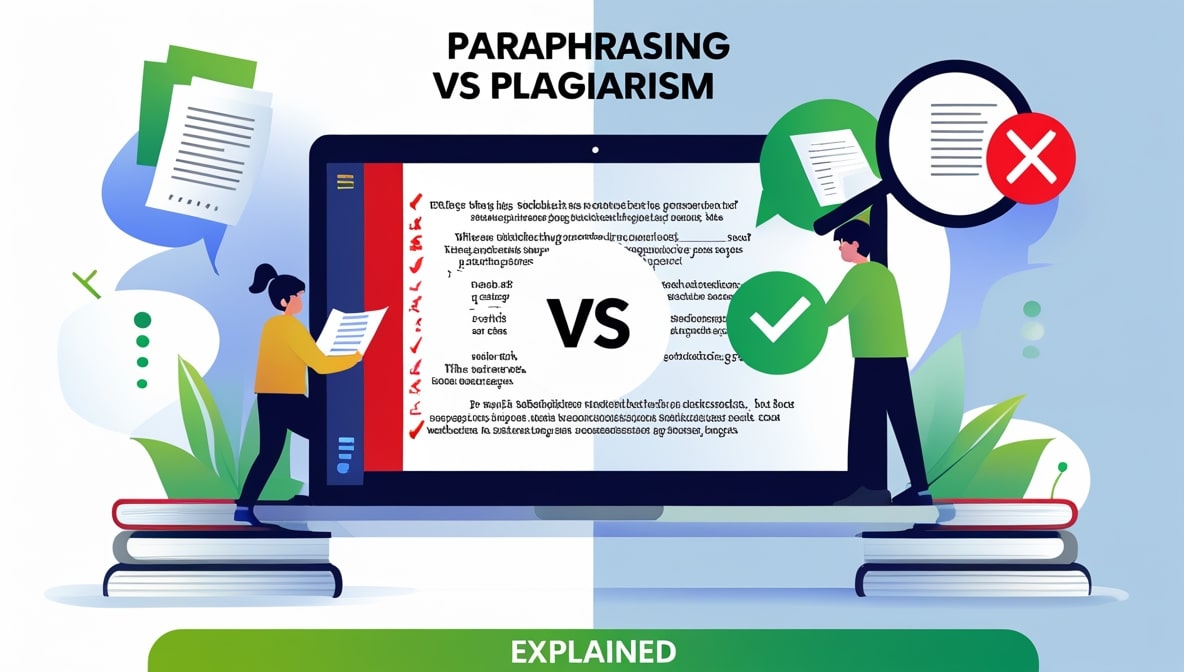
Difference Between Paraphrasing and Plagiarism Explained
You’ve found the perfect source. It’s an article that says exactly what you need to support your argument, maybe even more eloquently than you could have yourself. You know you can’t just copy and paste it that’s plagiarism, the cardinal sin of writing. So you do what you’ve been taught to do: you paraphrase. You swap out some words, change the verb tenses, maybe flip a sentence around. You stare at your creation, then back at the original. And the question that haunts every student and writer pops into your head: "Is this different enough?"
Where, exactly, is the line between skillfully incorporating a source into your work and committing plagiarism? It can feel like a blurry, intimidating gray area, but I’m here to tell you that it’s not. The line between paraphrasing and plagiarism is actually bright, clear, and much easier to navigate than you think. The difference isn't just about changing a few words; it's about your entire approach, your process, and your fundamental understanding of the material. So let’s break it down, once and for all.
Let's Bust a Myth: It's Not About Changing Words
Here’s the single biggest misconception that gets writers into trouble: the idea that paraphrasing is a game of "how can I say the same thing with different words?" This approach is flawed from the start. It leads to a frantic search through a thesaurus and a clumsy rearranging of sentences, all while trying to stay as close to the original idea as possible. That’s not paraphrasing; that's just putting someone else’s thoughts in a cheap disguise.
True paraphrasing isn't about disguising a source; it’s about demonstrating your understanding of the source. It’s a process of absorbing information, digesting it, and then explaining it from your own perspective, in your own unique voice. When you do it right, it’s one of the most powerful tools in your writing toolkit. When you do it wrong, you slip into plagiarism, even if you had the best of intentions.
Introducing Our Source Text for Today
To make this crystal clear, we need a concrete example to work with. Let’s imagine we’re writing a research paper on the history of medicine and we find the following paragraph in a fictional book titled Medical Milestones by Dr. Alistair Finch.
Here is our source text:
"Alexander Fleming's accidental discovery of penicillin in 1928 at St. Mary's Hospital in London is a landmark event in medical history. He returned from a holiday to find that a petri dish containing Staphylococcus bacteria had been contaminated by a blue-green mold, and that the bacteria around the mold had been destroyed. This keen observation led him to the conclusion that the mold produced a substance that was lethal to bacteria, a substance he would later name penicillin."
Now, let's explore the wrong and right ways to incorporate this information into our paper.
This Is What Plagiarism Looks Like
A writer who misunderstands paraphrasing might read Dr. Finch’s paragraph and write something like this in their own essay.
Let's call this "The Thesaurus Trap" version:
A major moment in the history of medicine was Alexander Fleming’s chance discovery of penicillin in London at St. Mary's Hospital in 1928. After a vacation, he observed that a petri dish with Staphylococcus germs was tainted with a mold, and the germs near the mold were eradicated. This sharp observation guided him to decide that the mold made a substance that was deadly to germs, which he eventually called penicillin.
Does that sound familiar? It’s a classic case of what’s called "patchwriting." It follows the original text like a shadow, keeping the exact same sentence structure and logical flow while simply swapping out individual words. "Accidental" becomes "chance," "bacteria" becomes "germs," "destroyed" becomes "eradicated." This might feel like paraphrasing, but make no mistake: this is plagiarism.
Why the "Thesaurus Trap" Fails Every Time
So, why is that patchwritten example still considered plagiarism? Because the intellectual work the sentence construction, the ordering of ideas, the rhythm of the explanation is not your own. You haven't contributed any original thought or demonstrated any real understanding. You've just given Dr. Finch’s words a new coat of paint, but the underlying machine is entirely his.
Search engines and university plagiarism detectors are incredibly sophisticated now. They don’t just look for direct word-for-word matches. Their algorithms are designed specifically to spot these kinds of structural similarities and flag them. This shortcut simply doesn’t work, and trying to use it is one of the fastest ways to get a failing grade or a penalty on your work. It's a fundamental misunderstanding of what you're being asked to do as a writer.
So, What Is True Paraphrasing, Then?
If paraphrasing isn't about changing words, what is it? It’s a process that happens more in your brain than on your keyboard. The best way to ensure you're truly paraphrasing is to follow a simple but powerful method. First, read the original passage a few times until you are absolutely confident that you understand its core meaning.
Second and this is the most important step hide the original source. Close the book, switch to a different browser tab, or cover it with your hand. Now, try to explain the concept you just learned in your own words, as if you were telling a friend about it. Write it down from your memory of the idea, not your memory of the sentences. By forcing this mental separation, you will naturally use your own vocabulary and your own way of structuring a sentence.
The Two Unbreakable Rules of Paraphrasing
When you boil it all down, successful, ethical paraphrasing rests on two golden rules. If you follow both of them, every single time, you will never have to worry about accidentally plagiarizing.
The first rule is that the passage must be in your own words and your own original sentence structure. This means you can’t just change a few words, and you can’t just rearrange the clauses of the original sentence. You need to come up with a genuinely new way of explaining the idea.
The second rule is that you must always cite the source of the idea. This is the part people often forget. Even if you have crafted a perfect, completely original paraphrase, the core idea, the discovery, or the data still belongs to the original author. Failing to give them credit is like claiming their research as your own. You have to follow both rules. No exceptions.
A Successful Paraphrase in Action
Okay, let's go back to our Dr. Finch example about penicillin. We've read it, we've hidden it, and now we're going to write our own version from scratch, remembering to follow our two golden rules.
Here is what a good, ethical paraphrase could look like:
According to Dr. Alistair Finch, the discovery of penicillin was a stroke of luck that fundamentally changed medicine. In 1928, Alexander Fleming noticed that mold had accidentally contaminated one of his bacterial cultures. He keenly observed that the bacteria could not grow in the area immediately surrounding the mold, leading him to theorize that the mold was releasing some kind of antibacterial agent (Finch).
Let's break down why this works. The sentence structure is completely different. It starts with the impact of the discovery before explaining the process. It uses different phrasing ("stroke of luck," "bacterial cultures," "antibacterial agent") that demonstrates genuine understanding. And, most importantly, it clearly attributes the information to its source, both by introducing the author and with a formal citation at the end.
Let's Talk About That Second Rule: The Citation
I really want to hammer this home. That beautiful paraphrase we just wrote would still be plagiarism without the citation. Why? Because you, the writer, did not discover that Alexander Fleming found penicillin in 1928. You learned it from Dr. Finch. Citing your source isn't a sign of weakness; it’s a sign of academic honesty and credibility.
Think of it this way: if you tell a friend the entire, amazing plot of a new movie you saw, you're using your own words. But if you never mention the movie's title and let your friend think you made the story up, you're lying. You're taking credit for someone else's creative work. A citation is simply telling your reader the title of the "movie" where you learned this information. It's that simple, and it's that important.
When Should You Quote Instead?
This brings up a good question. If you have to do all this work to paraphrase, why not just use a direct quote? You should use a quote when the original author’s exact words are more powerful, memorable, or precise than any paraphrase could be. For example, if you're quoting a famous line from a piece of literature ("To be, or not to be"), a specific legal definition, or a statement from a historical figure, you should use their exact words in quotation marks.
Paraphrasing, on the other hand, is for when the idea is more important than the specific wording. It's used to summarize data, explain a concept, or incorporate supporting evidence smoothly into the flow of your own paragraph. Most of your source integration in a research paper will likely be paraphrasing.
How to Be Sure Your Paraphrase is Original
Even with the best of intentions, that little voice of doubt can creep back in. After you’ve written your paraphrase, you might look at it and still wonder, "Is this too close?" Your phrasing might have unintentionally mirrored the original source simply because it's fresh in your mind. This is where a final, objective check can be your best friend.
After you’ve done the hard work of writing, running your paper through a reliable plagiarism checker is a crucial quality control step. It’s not about catching yourself cheating; it’s about catching those innocent mistakes and accidental overlaps that can happen to any writer. It’s like having a proofreader who specializes in originality.
The Final Step for Peace of Mind
A high-quality tool, like the one we provide here at plagiarism-checker.free, can give you that final burst of confidence before you submit your work. Simply paste your text into the checker. It will compare your writing against billions of sources and highlight any phrases that are too similar to existing content. This allows you to review your paraphrasing with fresh eyes. You might spot a sentence that needs a bit more rewriting or realize you forgot a citation for a specific point. It's a simple, fast way to ensure that your hard work is presented honestly and professionally.
The Bright Line Between a Tool and a Shortcut
In the end, the difference between paraphrasing and plagiarism is the difference between a tool and a shortcut. Paraphrasing is a tool that skilled writers use to build powerful, credible arguments supported by research. It shows respect for the original source and a deep engagement with the material. Plagiarism is a shortcut that attempts to bypass the hard work of learning and understanding. It’s a dead end that undermines your credibility. By focusing on genuine understanding first and foremost and always, always giving credit where it's due you can wield the power of paraphrasing with skill, confidence, and complete integrity.