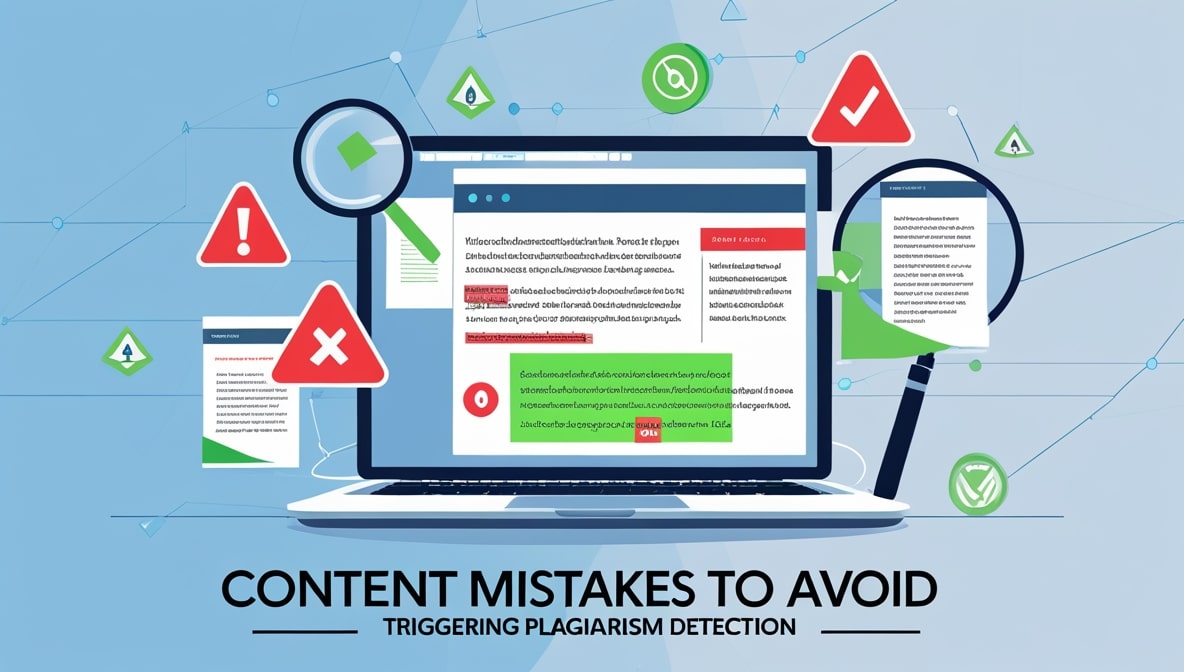
10 Common Content Mistakes That Trigger Plagiarism Detection
10 Common Content Mistakes That Trigger Plagiarism Detection
You’ve done the work. You spent hours researching, writing, and editing. You’re proud of the piece you’ve created, and you’re confident that you didn’t just copy and paste from your sources. You were careful. But then you run your work through a plagiarism checker, or worse, your professor or editor does, and the result comes back with a startlingly high similarity score. Your heart sinks. How is this possible?
It’s a frustrating and all-too-common experience. Most writers don’t set out to plagiarize, but they fall into common traps subtle, often accidental mistakes that modern, sophisticated detection algorithms are specifically designed to find. These tools don't just look for blatant, word-for-word copying anymore. They analyze sentence structures, patterns, and sources in ways that can flag content that a writer might have honestly thought was original.
So, let’s pull back the curtain and look at the common, often unintentional content mistakes that can get your work flagged. Understanding these pitfalls is the first step to avoiding them and ensuring the work you submit is truly, and verifiably, your own.
The Classic "Thesaurus" Paraphrase
This is, without a doubt, the most frequent offender. It’s born from a misunderstanding of what paraphrasing actually is. A writer takes a sentence from a source, carefully swaps out a handful of words with their synonyms, maybe shuffles a clause or two, and calls it a day. They think because the words are different, the sentence is now theirs.
But to a plagiarism checker, this is a dead giveaway. The underlying sentence structure, the rhythm, and the core DNA of the sentence are still identical to the original. For example, if a source says, "The rapid urbanization of the 19th century led to significant public health challenges," the writer might produce, "The fast city growth in the 1800s caused major public wellness problems." It’s just a disguise, and a flimsy one at that. Sophisticated algorithms see right through it and will flag it as a match.
When Quotation Marks Go Missing
This is one of the most painful mistakes because it’s often a result of simple sloppiness, but it looks like the most blatant form of plagiarism. Here’s the scenario: during your research, you find a perfectly worded sentence and copy it into your draft, fully intending to put quotation marks around it and add a citation. But in the chaos of writing and editing, you forget. You move paragraphs around, clean up the grammar, and completely miss that you never added the quotation marks.
When a checker scans your document, it doesn't know your intentions. All it sees is a sentence in your paper that is a 100% verbatim match to a sentence in another source, with no attribution. It’s an instant red flag. This simple punctuation error can turn an honest mistake into what appears to be intentional theft.
The Perfectly Rewritten but Uncited Idea
Here we have the opposite problem. A writer does an absolutely beautiful job of paraphrasing. They read a source, fully digest the concept, and then explain it in their own unique voice, with a completely different sentence structure. The words are 100% original. But then they fail to do one crucial thing: cite the source of the idea.
This is a huge pitfall. Paraphrasing is a two-part process: rewriting the words, and attributing the thought. Forgetting the second part is still plagiarism. The core discovery, the data, the theory, or the unique concept isn’t yours just because you explained it well. By omitting the citation, you are implicitly claiming that original thought as your own, and that’s a form of intellectual dishonesty that checkers can’t spot, but a knowledgeable professor or editor certainly will.
Accidentally "Borrowing" Sentence Structure
This is a more subtle mistake that better algorithms are getting very good at catching. It goes a step beyond the thesaurus paraphrase. You might do a decent job of changing the words, but your new sentence follows the exact structural pattern of the original. You’re using the source's sentence as a rigid template for your own.
For instance, if the source says, "Although the initial results were promising, the long-term data revealed a significant and unexpected decline," you might write, "While the early findings seemed positive, the later information showed a large and surprising drop." The vocabulary is different, but the cadence and the grammatical structure a dependent clause followed by an independent clause with two adjectives are identical. This structural mirroring can still be flagged as a high similarity.
Forgetting That Common Phrases Can Be Flagged
Sometimes, you can get flagged for using phrases that aren't necessarily unique but are common within a specific industry or academic field. These are often called "boilerplate" phrases or clichés. For example, in a business report, you might write a sentence like, "We must leverage our core competencies to achieve a paradigm shift in the marketplace." It feels like a standard, throwaway phrase.
The problem is, thousands of other business reports have used that exact same phrase. While a single instance might not cause much of a stir, if your document is sprinkled with these common, multi-word phrases that match other sources, your overall similarity score can start to creep up. It’s a reminder to strive for fresh, precise language instead of leaning on well-worn clichés.
When Your Citation Itself is the Problem
Sometimes the issue isn't a lack of citation, but a sloppy or incorrect one. You might have the wrong page number, misspell the author's name, or get the publication year wrong. This can lead to a high similarity score in a couple of ways. First, if you’re using a system like Turnitin that checks against a database of student papers, it might not be able to correctly exclude a quote from its analysis if the citation is formatted incorrectly.
More importantly, from a human perspective, a sloppy citation shows a lack of academic care. To a professor, an incorrect citation for a quote is almost as bad as no citation at all, because it shows that you aren't paying attention to the details of academic honesty.
Relying Too Heavily on a Single Source
This is an issue of originality rather than outright plagiarism, but it will absolutely trigger a high score on a plagiarism checker. Let's say you're writing a two-page summary of a research article. Even if you cite the article correctly for every single point you make, the checker is going to report that 80% or 90% of your paper is "similar" to that one source. And it’s right.
While it may not be plagiarism in the sense of stealing, it demonstrates a failure to synthesize information from multiple sources or to add your own original insight. It's a sign of lazy research. A good piece of writing should be a conversation between many sources, with your own voice acting as the moderator, not just a monologue summarizing one single text.
The Trap of Reusing Your Own Material
This one always surprises people. How can you plagiarize yourself? It’s called self-plagiarism, and in many academic and publishing contexts, it’s a serious breach of ethics. If you wrote a paper for a history class last year, you cannot submit that same paper for a sociology class this year. Each assignment requires new, original work.
Likewise, for bloggers or content creators, republishing large sections of your old articles in new ones without any disclosure is a bad practice. Not only is it a form of self-plagiarism, but it also creates duplicate content, which can harm your website’s SEO. Plagiarism checkers that have access to institutional databases or have indexed your blog in the past can easily flag this kind of reuse.
The Problem That Starts in Your Notes
This is the root cause of so many of the mistakes we've discussed. The path to accidental plagiarism often begins in the note-taking phase. In a rush, you’re copying and pasting interesting sentences from your sources into a single research document. You tell yourself you’ll paraphrase them properly later. But weeks go by, and when you return to your notes, your brain has forgotten which words are yours and which are copied.
A brilliant sentence you pasted from a source now feels like your own brilliant thought. You incorporate it into your paper without citation, not out of malice, but because of a disorganized research process. This is why keeping your own thoughts, your paraphrased notes, and your direct quotes meticulously separate from the very beginning is so critical.
How to Catch These Mistakes Before They Happen
Reading through this list can be a little intimidating. The common thread is that many of these errors are accidental, born from rushing, disorganization, or a simple misunderstanding of the rules. So how do you protect yourself? You do it by building a final, non-negotiable quality control step into your writing process: a thorough check with a high-quality plagiarism detection tool.
Think of it like a final proofread. You would never submit a paper without checking for spelling and grammar errors. An originality check is just as important, if not more so. It’s your chance to be your own editor and to catch these common but costly mistakes before anyone else does.
Your Final Proofread for Originality
This is exactly why we built the tool at plagiarism-checker.free. We wanted to provide a simple, powerful, and accessible way for writers to perform this essential final check. By pasting your work into our checker, you are using a sophisticated algorithm as your second set of eyes. It can instantly spot a forgotten set of quotation marks, a paraphrase that’s still too close to the original's structure, or an over-reliance on a single source. It gives you a clear, actionable report so you can fix these issues and submit your work with confidence.
Writing with Confidence in a Digital World
In today's digital age, technology has made it easier than ever to detect plagiarism in all its forms. But that same technology has also empowered us as writers. We no longer have to guess or hope that our work is original. We can verify it. By being aware of these common pitfalls and by incorporating an originality check into your routine, you transform a source of anxiety into an act of professional diligence. You can move forward knowing that the words you are putting out into the world are truly, authentically yours.